Notes on The Five Wounds
The hand pump: how one iron pump changed water in India's villages
The iron hand pump that stands in almost every Indian village is usually an India Mark II. It was designed in India in the 1970s by the Government of India with UNICEF and the World Health Organization, after a drought showed that the pumps then in use broke down under village life. It has since gone to more than forty countries.
The drought that started it
In the summer of 1966, Bihar and eastern Uttar Pradesh suffered one of the worst droughts of the twentieth century. About sixty million people ran short of food and water. At the request of the Prime Minister, UNICEF sent drilling rigs that could bore through hard rock, and the emergency grew into India's national programme for rural drinking water.
Drilling was only half the problem. When the programme was reviewed in 1974, three quarters of the tens of thousands of wells drilled in the previous seven years were not giving water. The pumps on top of them, many of them lighter designs from Europe, could not survive a whole village using them from dawn to dark.
From Sholapur to the world
The answer came from Maharashtra. At a mission workshop in Sholapur, the Sholapur Well Service had built a heavy, simple lever pump for its own wells. Government engineers, UNICEF and the manufacturer Richardson and Cruddas worked from that design, and the result was the India Mark II. (There was never a Mark I.)
It became a national standard and a national industry. By the mid 1990s, millions had been made and installed, and it had been exported to more than forty countries.
How it works
Pushing the handle down lifts a long steel rod inside the well. At the bottom, often fifty metres down, the rod moves a plunger in a cylinder, and each stroke lifts a little under half a litre of water to the spout. It needs no electricity and no fuel, only an arm.
Its weakness is the one every village knows. The galvanised pipes can rust within a few years, and replacing parts deep in the well needs a trained mechanic. Later designs such as the India Mark III were made so that a village could repair its own pump.
The pump as a meeting place
A hand pump is never only a machine. It is where the morning begins, where news is passed on, where a queue decides without a word who goes first. In many small towns the pump beside a dispensary or a school is the most public place there is.
The pump in The Five Wounds
In Peacetime, Book Two, the town gathers at one:
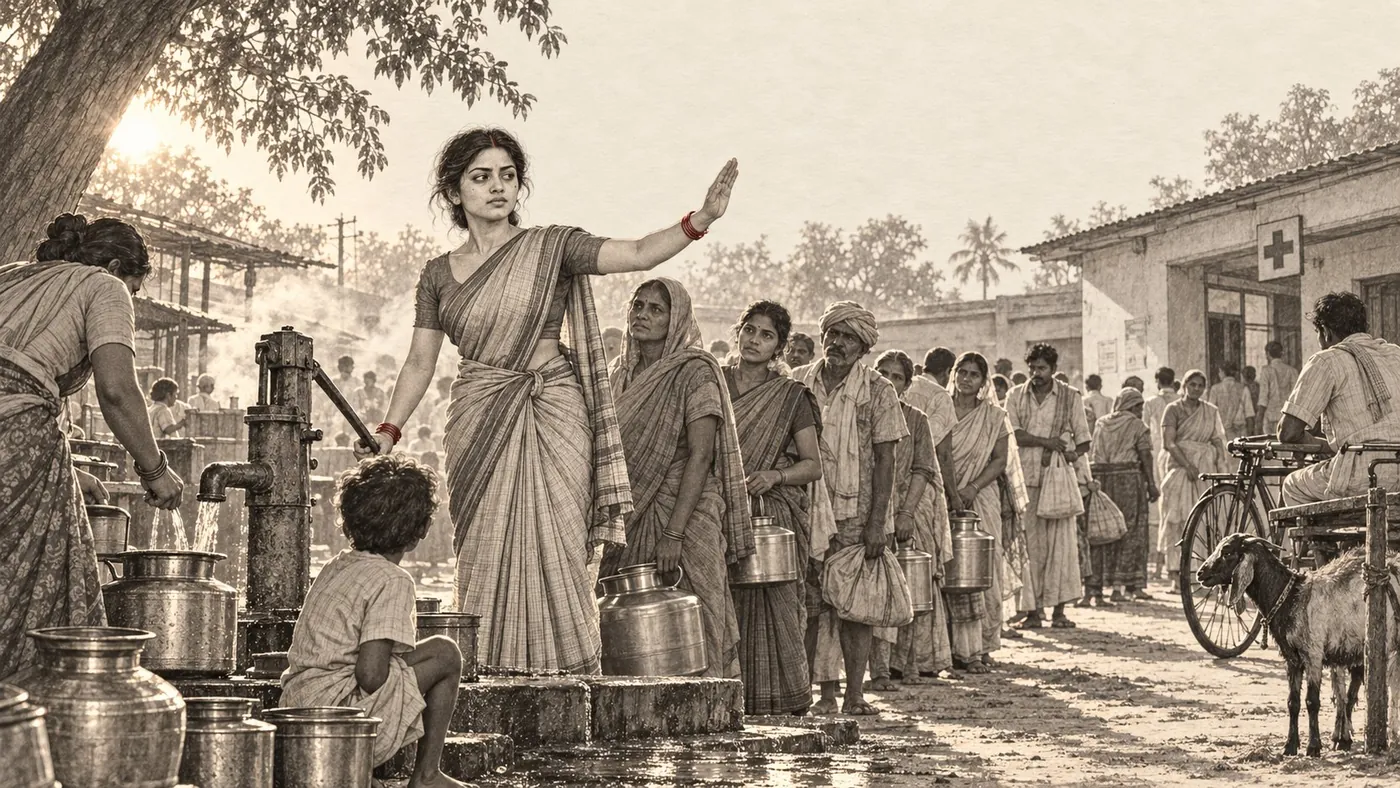
Six o’clock at the dispensary pump, and a queue kept in order with one raised hand.
And Clean Hands, Book One, has its own scene there: "Father, son and mother at the water. The grace the whole book walks toward."
Quick answers
What is the India Mark II hand pump?
A human powered deep well hand pump designed in India in the 1970s by the Government of India with UNICEF and the World Health Organization. It is the most common village hand pump in India and has been exported to more than forty countries.
Who designed the India Mark II?
It grew out of a lever pump built by the Sholapur Well Service in Maharashtra, developed by government engineers, UNICEF and the manufacturer Richardson and Cruddas.
Was there an India Mark I?
No. There was never a Mark I, only the Mark II and the later Mark III.
How deep can an India Mark II pump water from?
It is built to lift water from around fifty metres down, and can work deeper.